Body Doubling for ADHD: How to Do It With a Partner, a Friend, or Alone
You've been "about to" do the dishes for two hours. Then someone walks into the kitchen and sits down with their coffee, and suddenly you're done. Nothing about the dishes changed. Someone was just there.
That's body doubling. It sounds too simple to work, and for a lot of ADHD brains it's one of the few things that reliably does. Here's what it is, why it helps, and how to do it in every situation: with your partner, with a friend who lives far away, and when there's nobody around at all.
What is body doubling?
A body double is just company. Your partner reading on the couch while you answer emails. A friend on a video call, both of you quiet, each doing your own thing. Someone you've never met in a co-working session online. They don't check your work and they don't tell you what to do. Usually you each say what you'll work on, and then you just work at the same time.
The term is usually credited to ADHD coach Linda Anderson, and it spread through ADHD coaching and, later, through TikTok and Reddit. Lots of people realize they've been doing it for years without a name for it: studying only at the library, cleaning only while on the phone with their mom.
Why does body doubling work?
Honestly, there's very little formal research on body doubling itself, so we won't tell you it's "proven." Here's what a lot of people with ADHD describe:
- Starting feels lighter. The hardest part of almost any task is the first minute. When someone's there, that first minute stops being a solo fight.
- You said it out loud. "I'm doing my taxes for 25 minutes" is a tiny promise. You don't want to break it in front of someone, even if they'd never say a word.
- It's easier to notice drifting off. When you look up from your phone and see someone working, you remember what you were doing.
- Boring gets a little less boring. A lot of ADHD brains want more stimulation. Another person in the room is just enough of it.
Psychologists have studied a related effect for over a hundred years: social facilitation, where people often do simple, familiar tasks better when others are around. Body doubling may work partly the same way.
How to body double: a 4-step session
This works the same way in a room, on a call, or with a video.
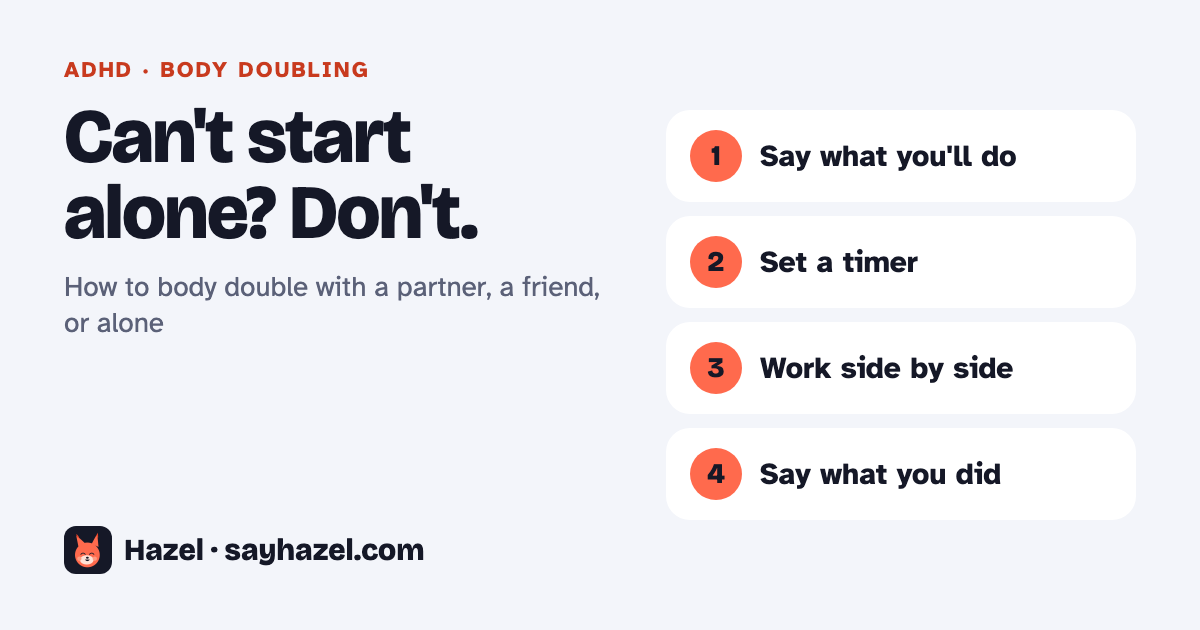
- Say what you'll do. One task, said out loud or typed in a chat. Small and specific: "reply to 3 emails," not "work." Not sure which task? Do a quick brain dump first to pick one.
- Set a timer. Many people use 25 or 50 minutes (that's how long Focusmate sessions are). If that sounds like too much, start with 10.
- Work side by side. Mostly quiet. You don't have to talk, and you don't have to be on the same task.
- Say what you did. "Did 2 of the 3 emails." Whatever you got done counts. Then take a break or go again.
We made a one-page card with these four steps and space to write your task, so you can stick it on the fridge or next to your laptop.
⬇ Download the free session card (PDF)
How to body double with your partner
If you live with someone, you already have the easiest body double there is. It just needs a couple of rules, so it stays company and doesn't turn into supervision.
- Ask for presence, not help. "Can you sit with me while I fold laundry?" is a different ask from "help me fold laundry." They can read, game, or scroll. Being there is enough.
- They're not your manager. No "are you done yet?", no checking. If they start nagging, it stops being body doubling and starts feeling like school.
- Pick a shared slot. "Sunday at 11 is our reset hour" works better than asking from scratch every time.
- Trade. Offer to be their body double too, for their thing. It keeps it from feeling one-sided.
How to body double with a friend (even far away)
This is how my co-founder Alina found out body doubling works. She kept putting off studying French, even though she likes it. One day she texted Sofia, "I can't make myself sit down and study French." Sofia wrote back, "Let's study together." They got on a call, and Alina finally started. (She wrote the whole story in The Anxiety–Procrastination Loop.)
- Video call, camera on, mic off. The closest thing to sitting at one table.
- Audio only. Great for chores where you're moving around the house.
- Text check-ins. "Starting the laundry now" … "done!" It's the lightest version, and it still works for a lot of people.
If asking feels awkward, here's a message you can copy:
How to body double alone (without another person)
No partner around, friends busy, or just no social energy today? You can still borrow someone's presence:
- Study-with-me or clean-with-me videos. Search YouTube for "study with me," "clean with me," or "work with me." Someone works on screen for an hour, often with a timer.
- Live co-working streams. Same idea, but live, with a chat where people post what they're working on.
- Virtual co-working sites. Focusmate, Flow Club and similar sites let you work alongside other people in a session. Some have free plans.
- Discord servers. Many ADHD servers have voice channels just for co-working.
- Go where people are. A library, a café, a co-working space. Strangers count.
- Talk it out. Say what you're about to do and the very first step out loud: to yourself, into a voice memo, or to an app. It's not the same as a person, but saying it often gets you over that first minute.
Body doubling ideas: what to use it for
Is body doubling only for ADHD?
No. The term comes from the ADHD world, but plenty of autistic people, anxious people and people with no diagnosis at all find it easier to get things done with someone around. If it works for you, you don't need a diagnosis to use it.
When body doubling doesn't work
- You're out of social energy. Then a person is too much. Try a video, or a library, where nobody expects anything from you.
- Your body double talks the whole time. Agree on "quiet mode" before you start.
- The task is still a mountain. Someone being there won't make "clean the whole apartment" feel doable. Shrink it first: "clear the kitchen counter."
How Hazel helps
We're building Hazel, a planner for ADHD brains. You just say everything that's on your mind, and Hazel turns it into a small plan for today and the next few days. Tap any task to break the mountain into tiny steps, so you know exactly what to do in your next body doubling session.
Hazel isn't a body double. But we'd love to know: would you want to invite a friend or your partner to "be there" while you start a task in your planner? Tell us on Threads (@sofia.adhd). We read every reply.
Head full before you even begin? Start with a brain dump. Curious why starting is so hard for you? Take our 2-minute ADHD brain type test.
Body doubling FAQ
What is body doubling?
Body doubling means doing a task while another person is there with you, in the same room or on a call. They don't help with the task. They're just there, and that makes it easier to start and keep going.
Why does body doubling work for ADHD?
There's very little formal research on body doubling itself. What many people with ADHD describe is that another person's presence gives a gentle bit of outside structure: you said what you'd do, someone is there, so starting feels less heavy and drifting off is easier to notice. Psychologists have studied a related effect, social facilitation, for over a century.
How do you body double alone?
You can borrow someone's presence without asking anyone: put on a study-with-me or clean-with-me video, join a live co-working stream or a virtual co-working site, go to a library or café, or say out loud what you're about to do and set a timer.
Is body doubling only for ADHD?
No. The term comes from the ADHD world, but many autistic people, anxious people and people with no diagnosis at all find it easier to start when someone else is around.
Is body doubling codependency?
Not by itself. It only gets unhealthy if you can't do anything without one specific person, or if they start feeling responsible for your tasks. Mix it up: sometimes your partner, sometimes a friend on a call, sometimes a video.
Say what's on your mind. Hazel plans the day.
A planner for ADHD brains: just talk, and get a small day you can actually do. Free during early access.
Try Hazel →