ADHD Morning Routine for Adults: A Checklist That Actually Sticks
The alarm goes off. You check your phone "for a second." It's 40 minutes later, you haven't showered, your keys are somewhere, and you're about to be late.
If your mornings look like this, you're not bad at mornings. You're trying to run a long, invisible list at the exact moment your brain is still booting up. The fix isn't a 20-step "that girl" routine. It's a short one that's written down and done in the same order, and that still works on your worst day.
Why are mornings so hard with ADHD?
A morning is a chain: get up, bathroom, meds, shower, clothes, food, pack, leave. Each link is easy. The chain is not. Here's what a lot of people with ADHD run into:
- Time slips. "I have plenty of time" turns into "how is it 8:40" with nothing in between. Many people with ADHD call this time blindness.
- Every switch is a stall. Stopping one thing to start the next takes effort. Five small switches before 9 AM add up.
- Too many decisions. What to wear, what to eat, what to bring. Each one is small, and each one is a chance to drift.
- The phone. It's the first thing you touch, and it never ends.
- Things hide. Keys, charger, badge, the form you had to sign. Searching eats the minutes you didn't have.
None of this is a willpower problem. It's a "too much to hold in your head" problem. So the whole trick is to move the morning out of your head and onto paper (or a screen), and to make most of it happen the night before.
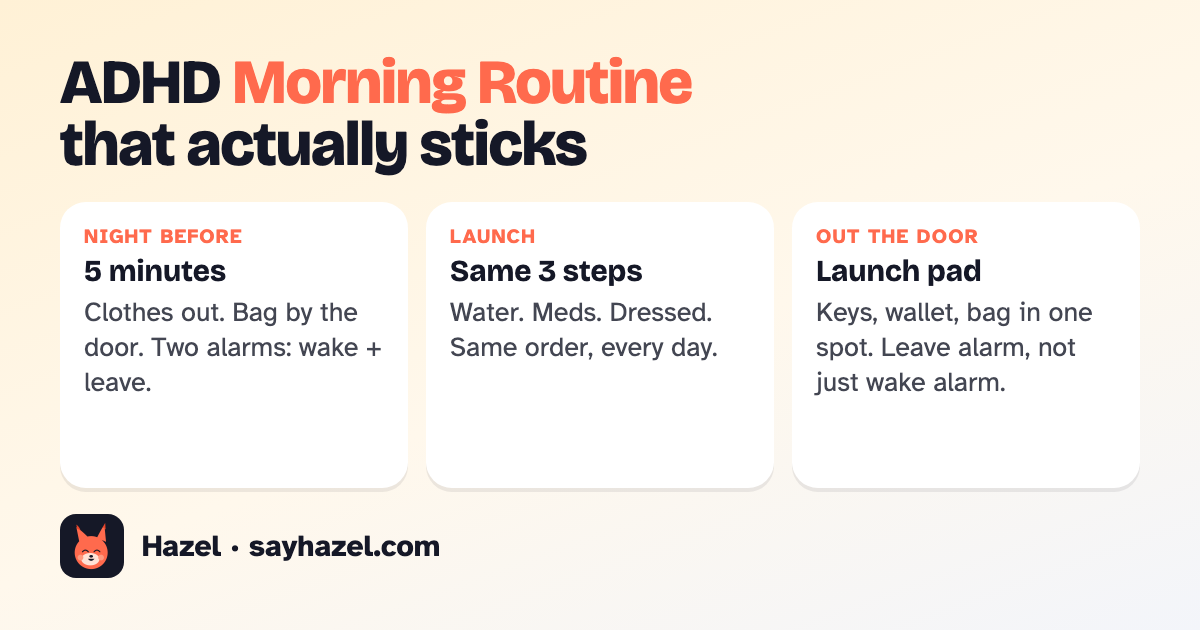
The ADHD morning routine in 3 parts
Part 1: The night before (5 minutes)
The best ADHD morning starts at 9 PM. Everything you decide tonight is one less thing to decide half-asleep.
- Clothes out. The whole outfit, on a chair. No choosing at 7 AM.
- Bag packed, by the door. Laptop, charger, lunch box, whatever tomorrow needs.
- Look at tomorrow. What's the one fixed thing (a meeting, school drop-off, a call)? What time do you need to leave?
- Set two alarms. One to wake up and one for when to leave.
Part 2: The launch (the same 3 steps, every morning)
Pick 3 first steps and do them in the same order every day, before anything else. The order matters more than what they are, because after a while you stop deciding and just go.
- Feet on the floor, water. Keep a glass or bottle by the bed. Drinking it is your "I'm up" signal.
- Meds or vitamins, if you take them. Put them next to the water or the toothbrush, so you can't do one without seeing the other.
- Dressed. The clothes are already on the chair. Getting dressed early makes it much harder to slide back into bed.
That's it. Shower, breakfast, makeup, coffee: add them after the launch, in an order that fits your life. Many people find a showered-but-not-dressed morning is the one that falls apart, so put "dressed" early.
Part 3: Out the door
- One launch pad. A bowl, a hook, or a basket right by the door. Keys, wallet, glasses, headphones, badge. Things live there, and only there.
- A leave alarm, not a wake alarm. Set it for when you need to walk out, not when you need to be there. Add a second one 10 minutes earlier that says "shoes."
- Plan backwards. Need to be there at 9, and it's 25 minutes away? Leave at 8:30. Shoes at 8:20. Now the morning has a shape.
If you work from home, your "door" is your desk. The leave alarm becomes a "start work" alarm, and your launch pad is a clear desk with your laptop and water on it.
The minimum routine (for bad days)
Some mornings everything goes sideways: you slept badly, your kid is sick, you woke up 30 minutes late. On those days, the full routine is off the table, and that's fine. Keep a 3-step minimum version:
Free printable: ADHD morning routine checklist for adults
We made a one-page checklist with all three parts and empty lines for your own steps. Print it and stick it where your morning actually happens: the bathroom mirror, the fridge, or next to the door. A checklist you can see works better than one you have to remember.
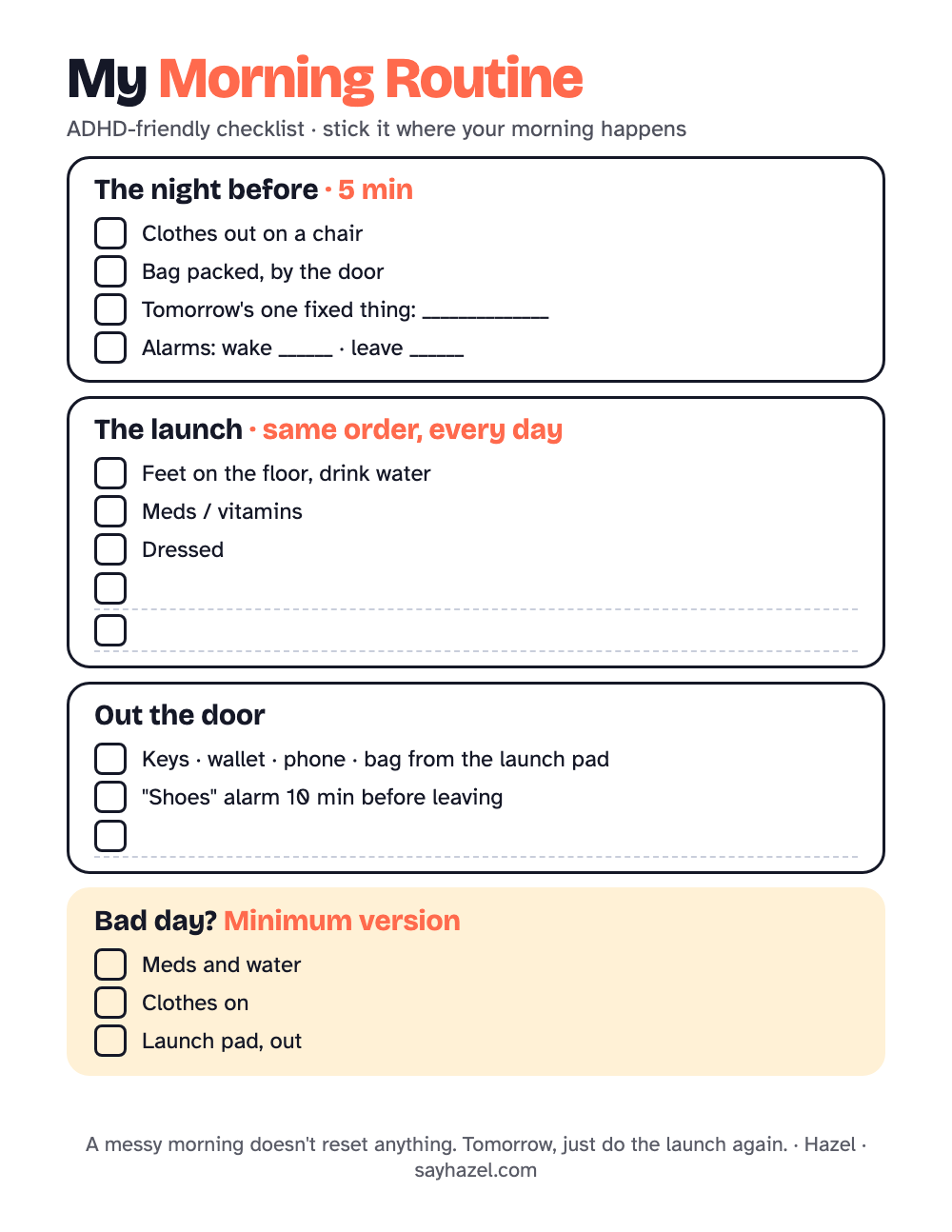
⬇ Download the free checklist (PDF)
How to make a morning routine stick
- Attach it to something you already do. Meds next to the coffee maker. The launch pad on the way to the door. New habits stick better when they're tied to an old one.
- Keep it where you can see it. Out of sight really is out of mind. The checklist goes on the wall, not in a notes app you never open.
- Change one thing at a time. Don't start a whole new routine on Monday. Add one step, keep it for a week, then add the next.
- Make the first step tiny. "Drink water" is easier to start than "get ready." Once you're moving, the next step is easier.
- Use a timer for the slippery parts. If the shower always turns into 25 minutes, put on a 10-minute playlist. When it ends, you're out.
- A messy morning doesn't reset anything. You don't start from zero tomorrow. You just do the launch again.
What to do about the phone
For a lot of us, the phone is where mornings go to disappear. You don't have to quit it. Just give it a later slot:
- Charge it away from the bed. A cheap alarm clock does the waking up, so the phone isn't the first thing you hold.
- Phone after the launch. Water, meds, dressed, then scroll if you want. The launch is already done.
- Give it one job first. If you do pick it up, open your checklist or your planner before any app with a feed.
How Hazel helps
We're building Hazel, a planner for ADHD brains. You just say what's on your mind, like "every morning take meds, leave at 8:30 for work, and I need to call the bank today," and Hazel turns it into a small plan for the day. Things you say "every morning" or "every day" come back each day by themselves. Nothing is saved until you say it looks good.
The Today screen shows one thing at a time, so the morning doesn't land on you all at once. Stuck on a step? Tap it to break it into tiny steps (with an account), or tap Start and a gentle timer keeps you company. With reminders on (they need an account), Hazel can remind you at the times you set. (On iPhone, reminders only work after you add Hazel to your home screen.)
Head too full in the morning to even pick a task? Start with a brain dump. Got one appointment later and can't do anything before it? That's waiting mode. Can't start alone? Try body doubling. Or take our 2-minute ADHD brain type test.
ADHD morning routine FAQ
Why are mornings so hard with ADHD?
A morning is a chain of small decisions and switches (get up, shower, dress, eat, pack, leave) that all have to happen in order and on time, right when your brain is just waking up. Many people with ADHD describe losing track of time, getting pulled into their phone, and stalling at every switch from one thing to the next.
What is a good ADHD morning routine for adults?
A short one with a fixed order: a 5-minute setup the night before, the same 3 first steps every morning (for example water, meds, clothes), one launch pad by the door for keys, wallet and bag, and an alarm for when to leave. Plus a minimum version for bad days.
How do I make a morning routine stick with ADHD?
Keep it short, attach each step to something you already do, keep the steps visible (a checklist on the bathroom mirror or by the door), change one thing at a time, and treat a messy morning as normal rather than a reason to start over.
How long does an ADHD morning routine need to be?
As short as you can make it. Many people do best with 3 to 5 steps and a time for leaving, plus a 3-step minimum version for days when everything goes sideways.
Is it OK to check my phone first thing in the morning?
If your phone is where your mornings disappear, charge it away from the bed and use a separate alarm clock, or give the phone one job first (like the checklist or a timer) before any apps.
Say what's on your mind. Hazel plans the day.
A planner for ADHD brains: just talk, and get a small day you can actually do.
Try Hazel →